How Do Ensemble Models Improve Machine Learning?
Ensemble learning methods are useful when one machine learning model is too unstable, too biased, or too dependent on one view of the data. The practical idea is simple: train several models, let them make predictions, then combine those predictions into one result that is often more reliable than a single model. They are not automatically better in every case, but they are a strong option when validation shows that one model is not enough.

What are ensemble learning methods?
Ensemble learning methods combine multiple machine learning models into one predictive system. Instead of asking one model to make the whole decision, the ensemble uses several base models and turns their outputs into a final answer.
Multiple models work together
The individual models in an ensemble are often called base learners or base models. They might all be the same type, such as many decision trees in a random forest, or they might be different model families, such as a tree model combined with a linear model and a support vector machine.
For a beginner working with tabular data, this usually means starting with a ready-made ensemble such as random forest or gradient boosting rather than manually building many models. For a more advanced project, it may mean testing several strong models separately and then combining them only if they add different strengths.
Predictions are combined into one result
After the base models make their predictions, the ensemble needs a rule for turning them into one output. Classification problems often use voting or probability averaging. Regression problems usually use numerical averaging or a learned combiner.
- Hard voting: models vote for a class label, and the most common label wins.
- Soft voting: predicted probabilities are averaged, which can be more informative than labels alone.
- Averaging: regression outputs are averaged into one final number.
- Meta-learning: a second model learns how to combine the first-level predictions.
Model diversity improves reliability
Diversity is the reason ensembles work. A group of nearly identical models will usually repeat the same errors, while a diverse group has a better chance of balancing out bad predictions from any one learner.
Diversity can come from different training samples, different feature subsets, different algorithms, or different hyperparameter settings. A random forest, for example, creates variation by changing both the rows and features seen by individual trees. Stacking creates diversity by using different model types that may capture different patterns.
How do ensemble learning methods work?
Most ensemble workflows follow the same basic path: train several base models, make sure they are not just copies of each other, combine their predictions, and return one final prediction. The details change between bagging, boosting, stacking, and voting, but the goal is always to use multiple views of the data more effectively than one model can.
Train multiple base models
Training multiple base models does not mean duplicating the same model in the same way. In bagging, each model is trained on a resampled version of the data. In stacking, different model types may train on the same dataset but learn different relationships.
For a small experiment, a few base models may be enough to test the idea. For tree-based ensembles, the number can be much larger because trees are relatively efficient and are designed to be combined. The useful check is simple: each model should contribute something different, not just add training time.
Create diversity between models
Diversity can be created by changing the data, features, model type, or training settings. Random forests use random row samples and random feature selection. Boosting creates a different kind of diversity by training later models to focus on errors from earlier ones.
Combine their predictions
The combination step should match the problem and the risk level. Simple averaging is easy to explain and often works well for regression. Voting is straightforward for classification. Stacking can be stronger, but it also needs more careful validation because the meta-model can learn leakage if it sees predictions made on data the base models were trained on.
| Combination choice | Best fit | Main caution |
|---|---|---|
| Voting | Quick classification baseline | Weak models can dilute the result |
| Averaging | Simple regression ensemble | Outlier predictions may pull the average |
| Weighted combining | Models have clearly different validation quality | Weights can overfit a small validation set |
| Meta-model | Different model families add separate value | Needs out-of-fold or holdout predictions |
Produce a final prediction
To the user or application, the ensemble still produces one prediction: a class, a probability, or a number. The difference is that the result is backed by several learners rather than one decision path.
In a low-risk project, such as predicting a rough sales category for internal planning, a simple random forest or averaged model may be enough. In a high-stakes setting, such as medical or financial decision support, the final prediction also needs careful validation, monitoring, and interpretability checks; stronger accuracy alone is not a sufficient reason to trust it.
Main types of ensemble learning
The main types of ensemble learning are bagging, boosting, stacking, and simpler voting or averaging methods. The best choice depends on what problem you are trying to fix: instability, weak accuracy, limited model variety, or the need for a simple baseline.
Bagging
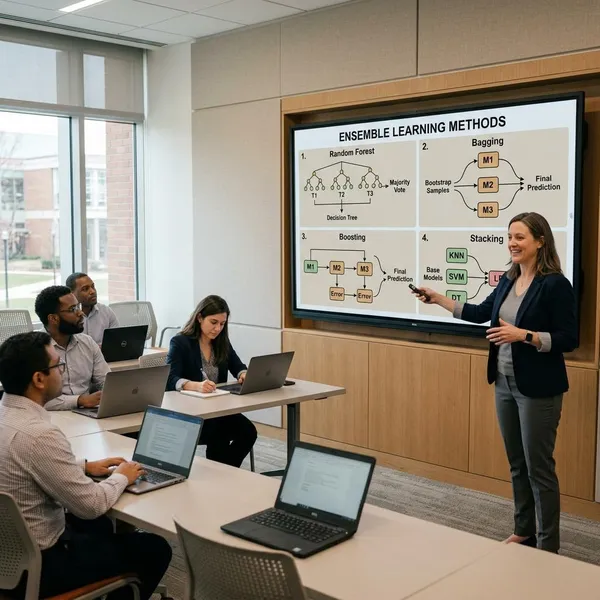
Bagging, short for bootstrap aggregating, trains many models independently on different resampled versions of the training data. Their predictions are then combined, usually by voting for classification or averaging for regression.
Bagging is especially useful when the base model has high variance. A single decision tree can change a lot when the training data changes slightly, but many trees averaged together are usually more stable. Random forest is the most familiar bagging-style method because it adds extra feature randomness to make the trees less alike.
If you want a dependable first ensemble without heavy tuning, bagging is often the safest place to begin. It is less likely than boosting to become fragile from aggressive settings, though it can still overfit if the validation process is weak or the data has leakage.
Boosting
Boosting builds models sequentially. Each new model tries to improve on the errors left by the previous ones, and the final prediction combines the whole sequence.
This approach can produce excellent performance on structured tabular data. AdaBoost, gradient boosting, XGBoost, LightGBM, and CatBoost all follow the broader boosting idea in different ways. The tradeoff is tuning: learning rate, tree depth, number of rounds, regularization, and early stopping can make a large difference.
Stacking
Stacking combines different base models and trains a meta-model to learn how their predictions should be used. For example, a linear model may capture broad trends while a tree model captures interactions and thresholds.
The important rule is to train the meta-model on out-of-fold or holdout predictions, not on predictions from models evaluated on their own training data. Without that separation, stacking can look much better in testing than it will be on new data.
Stacking makes the most sense for an advanced workflow where several model families already perform well but make different errors. It is usually not the first method to try if the goal is a clean, beginner-friendly baseline.
Voting and averaging
Voting and averaging are the simplest ensemble methods. They are useful when you already have a few reasonable models and want a low-complexity way to combine them without training a second-level model.
For classification, soft voting is often more useful than hard voting because it uses predicted probabilities instead of only class labels. For regression, averaging can reduce the impact of one noisy model, especially if the models are trained differently.
The main limitation is that simple combining does not fix poor base models. If one model is clearly weak or badly calibrated, adding it may hurt rather than help. A quick validation check should decide which models deserve a vote.
Conclusion
Ensemble methods are worth using when they solve a real modeling problem, not just because they sound more advanced. Start by checking whether your single-model baseline is unstable, biased, or missing patterns; then choose bagging for stability, boosting for stronger tuned performance, stacking for complementary model families, or voting and averaging for a simple combined baseline.