Is IXL Learning Effective for Students and Families?
IXL is usually a good fit when you want steady skill practice and clear progress data, not when you expect a full lesson-based curriculum. The mixed opinions in ixl learning reviews mostly come from that difference: some families love the structure, while others find the scoring and repetition stressful.

How does IXL work?
IXL works by breaking subjects into small skills, giving students practice questions, and tracking performance as they work. It is strongest when a student already has some understanding of the topic and needs review, reinforcement, or a clearer picture of weak spots.
Practice skills by grade and subject
IXL organizes practice by grade, subject, topic, and individual skill. That makes it easy for a fourth grader to review third-grade fractions, work on current grammar skills, or try a more advanced reading topic without switching platforms.
The format is mostly direct question-and-answer practice. That works well for students who like clear tasks and quick feedback, but it may feel flat for children who learn better through stories, projects, videos, or discussion. For a child who only needs 15 minutes of extra math fluency, the structure can be useful; for a child learning a brand-new concept, it may feel like being tested before being taught.
Track progress with SmartScore
SmartScore is IXL's main progress measure inside each skill. A student's score rises with correct answers and can fall after mistakes, especially when the score is already high. The idea is to measure consistency, not just a few lucky correct responses.
Find gaps with IXL Diagnostics
IXL Diagnostics can help identify areas where a student may need review. Instead of saying a child is simply "bad at math," it may point toward more specific trouble, such as place value, fractions, word problems, or measurement.
This is especially useful for homeschool planning or after a school break. If a student seems rusty in several areas, diagnostics can help you choose the first few skills to revisit rather than assigning broad review and hoping it helps.
Review progress with analytics
The analytics are one of IXL's more practical features. Adults can see skills practiced, time spent, score changes, and patterns in errors. That turns practice into something easier to respond to: reteach this, review that, slow down here, move on there.
What are the biggest benefits of IXL?
The biggest benefits of IXL are coverage, structure, and visibility. It gives students a large library of skills to practice, while giving adults enough information to see whether the practice is actually helping.
Large skill library
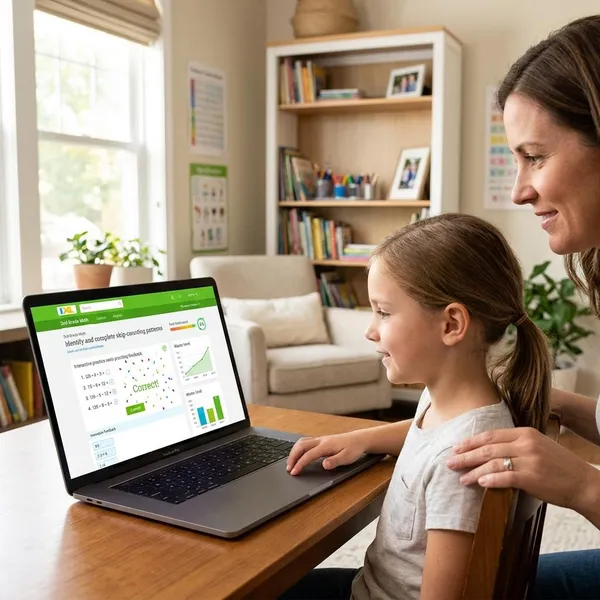
IXL's skill library is broad, especially in math and language arts. This is helpful for families with more than one child or for students who are uneven across subjects. One child might need basic multiplication review while another works on algebra or reading comprehension.
The useful part is not the size by itself. The value comes from being able to move up or down a level without making the student feel stuck in the wrong grade. That flexibility matters when a learner is ahead in reading but behind in computation, or strong in grammar but weak in inference.
Adaptive practice
IXL can recommend skills based on performance and diagnostic results. That reduces some of the guesswork for parents and teachers who are trying to decide what to assign next.
It is still not the same as a human tutor. If a child keeps missing a skill because the concept was never explained clearly, more adaptive practice may simply repeat the frustration. In that case, teach or model the idea first, then use IXL to check whether it stuck.
Detailed progress tracking
Progress tracking is where IXL often feels more useful than a basic worksheet site. You can see not only that a student practiced, but which skills were attempted and whether performance improved over time.
- For teachers: reports can show which students need the same reteaching.
- For homeschoolers: records can support planning and documentation.
- For parents: patterns can reveal whether a child is improving or just repeating familiar work.
Standards-aligned skills
IXL's standards alignment helps when you want practice that connects to school expectations. That can be useful before a test, after an absence, or when a parent wants to support classroom learning without guessing which topic comes next.
For homeschool families, standards can provide a useful checklist even if the home curriculum does not follow public school pacing exactly. The caution is simple: alignment makes the work relevant, but it does not automatically make it engaging.
Personalized recommendations
Personalized recommendations are helpful when a student has hidden gaps. A child may seem generally fine in language arts but repeatedly miss punctuation, vocabulary-in-context, or text evidence questions. Recommendations can bring those smaller issues into view.
How does IXL SmartScore affect learning?
SmartScore has a major effect on how students experience IXL. For some learners, it creates a clear goal and a satisfying sense of progress. For others, especially anxious or perfectionist students, it can make practice feel like a high-pressure test.
Scores rise as skills improve
At the start of a skill, SmartScore often moves up fairly quickly. That early progress can motivate students because they can see their effort turning into a visible result.
This works best for children who like measurable goals. A student who enjoys beating a target may find the score helpful, while a student who worries about every mistake may focus more on the number than on the learning.
Progress slows near mastery
Near the top of the score range, progress usually slows because IXL is looking for more consistent accuracy. Academically, that makes sense: answering a few questions correctly is not the same as secure mastery.
The problem is expectation. If a child moves from 40 to 75 quickly, they may assume 75 to 100 will feel the same. It often does not. A simple warning before practice can help: "The last part is slower because it is checking consistency."
Mistakes can lower the score
Mistakes can lower the SmartScore, and this is one of the main reasons some students dislike IXL. A wrong answer near mastery can feel especially discouraging because the student may have already worked hard to get there.
It helps to separate types of mistakes. A careless click, a misread question, and a true misunderstanding should not all be treated the same at home or in the classroom. If the mistake shows confusion, pause and teach. If it was a slip after 20 minutes of work, taking a break may be more useful than pushing for the score.
Mastery goals can add pressure
Requiring 100 on every skill can turn IXL into a battle for some students. Mastery goals are not wrong, but they work better when they are used selectively rather than as a rigid rule for every session.
- Use 100 when the skill is important, the student is calm, and the topic has already been taught.
- Use 85 or 90 when the student has shown strong understanding but is starting to fatigue.
- Use a time limit when the goal is steady practice without emotional overload.
Is IXL worth it?
IXL is worth it if it will be used regularly and someone will actually look at the data. It is less worth it if you only need occasional practice, want full lessons, or have a child who strongly resists score-based drills.
| Situation | IXL fit | Why it matters |
|---|---|---|
| Daily or weekly skill review | Strong | The reports and recommendations become more useful with regular use. |
| Rare homework backup | Weak | You may not use enough of the platform to justify the subscription. |
| Student already understands the topic | Strong | Practice can build speed, accuracy, and confidence. |
| Student needs the concept taught from scratch | Limited | Direct instruction should come before repeated questions. |
Worth it for regular skill practice
IXL makes the most sense when practice is part of a routine. Short, consistent sessions can help with math facts, grammar, vocabulary, punctuation, and reading comprehension skills that improve through repetition.
Worth it for detailed progress tracking
If you care about seeing exactly where a student is improving or stalling, IXL's tracking can justify the cost. The reports are especially useful when a child has a persistent weak area and you need more than a general impression.
Less useful for occasional practice
Occasional users usually get less value from IXL because the platform's best features depend on repeated use. Diagnostics, recommendations, and progress trends become more meaningful when there is enough activity to analyze.
Less suitable as your only learning resource
IXL is not ideal as the only learning resource because it leans heavily toward practice and assessment. Students still need explanations, examples, discussion, writing, reading, and sometimes hands-on activities.
Conclusion
IXL is a strong choice when you want structured practice, clear skill coverage, and detailed progress tracking, but it is not the best fit for every learner. I would consider it worthwhile for regular review or homeschool support if the student can handle the scoring system and an adult is willing to guide the routine. If practice often turns into stress, or if the child needs lessons more than drills, another resource should take the lead.