Is There Really a Visual vs Auditory Learning Differnce?
Visual and auditory methods are different, but that does not mean you have one fixed learning style that always wins. Visual methods usually help when information has shape, layout, sequence, or relationships; auditory methods help more when sound, speech, explanation, or language flow matters. The better study choice is the one that helps you recall and use the material later, not just the one that feels most comfortable while studying.

When do visual and auditory methods work best?
Start with the type of information, not with a label for yourself. If the material depends on seeing relationships, visual tools are usually the stronger first choice. If the material depends on how something sounds or how an explanation unfolds, audio or spoken practice often makes more sense.
| What you are learning | Method to try first | Quick check |
|---|---|---|
| A process, structure, comparison, map, timeline, or system | Visual notes, diagrams, tables, flowcharts | Can you redraw or explain the relationships without looking? |
| Pronunciation, speeches, lectures, dialogue, rhythm, or tone | Listening, repeating aloud, discussion, recorded explanation | Can you say it clearly or recognize the meaning by sound? |
| A difficult concept with both structure and explanation | Use both: sketch it, then explain it aloud | Can you recall the idea after a short delay? |
Visuals for spatial and structured information
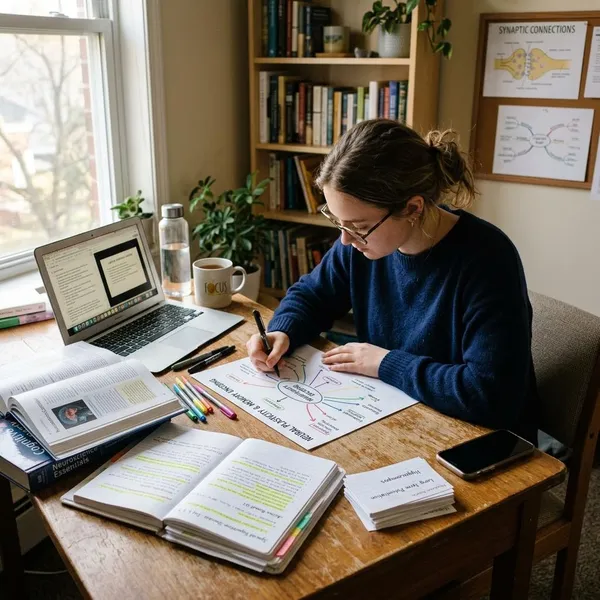
Visuals are strongest when the information has parts that connect. A rough flowchart, timeline, mind map, labeled sketch, or side-by-side comparison can make the structure visible instead of forcing you to hold every piece in your head.
Use visuals when you are dealing with categories, steps, cause and effect, locations, or comparisons. A history timeline, a geometry sketch, a biology diagram, or a project workflow usually becomes easier when you can see the whole pattern at once. Color can help, but only if it has a job: for example, one color for definitions, one for examples, and one for formulas. If everything is highlighted, nothing stands out.
Audio for spoken and language-based information
Audio works best when sound carries part of the meaning. Language pronunciation, poetry, speeches, interviews, presentations, and discussion-heavy subjects often lose something when you only read them on a page.
How to study with visual and auditory methods
The strongest study routine usually combines input with retrieval. Seeing a diagram or hearing an explanation can help you understand the material, but the real test is whether you can bring it back without the page, video, or recording in front of you.

Turn ideas into diagrams or notes
Turn messy information into a format that shows the logic. For a process, draw arrows. For a comparison, use columns. For a chapter with many terms, group related ideas instead of copying every sentence. The point is not to make pretty notes; it is to force yourself to decide what matters and how the parts connect.
Explain concepts out loud
Explaining aloud is useful because it exposes weak spots quickly. If you can only say, "I kind of understand it," you probably do not understand it well enough yet. Try teaching the idea to an imaginary beginner, a classmate, or your phone recorder.
This is especially helpful before an exam, presentation, or meeting where you will need to use the idea under pressure. Reading silently may feel smoother, but speaking forces you to put the concept in order.
Combine words with useful visuals
Use words and visuals together when one format alone leaves gaps. A diagram can show the structure, while a short spoken or written explanation can explain what is happening inside that structure.
- Science process: draw the cycle, then explain each step aloud.
- History topic: make a timeline, then describe the cause-and-effect chain.
- Language study: listen to pronunciation, then write a few example sentences.
- Work training: sketch the workflow, then talk through what you would do first, next, and last.
Test yourself from memory
Memory testing is the part many learners skip, even though it gives the clearest answer. After studying a short section, close the material and try to recall it. Write the main points, redraw the diagram, answer practice questions, or explain the concept aloud.
- Study one small topic for 15 to 20 minutes.
- Put the material away.
- Recall the main ideas without looking.
- Check what you missed or mixed up.
- Review only the weak spots before testing again later.
Review over spaced sessions
For long-term learning, spaced review usually beats cramming. Review once after the first study session, again the next day, then again a few days later. Keep each review short, but include recall every time.
This also helps you judge visual and auditory methods more fairly. A diagram may help you understand the topic today, while explaining it aloud may help you remember it next week. If you only judge by the first session, you may choose the method that feels easiest instead of the one that lasts.
How to find the learning method that works for you
Do not rely on a learning-style quiz to decide how you should study. Use a small test instead. The method that works for you is the one that improves recall, accuracy, and application after a delay.
Comfort can be misleading. Passive listening, highlighting, and rereading often feel productive because the material becomes familiar. A better check is whether you can still explain it tomorrow or use it in a new problem.
Try different study formats
Pick one short topic and study it in two or three ways. For example, make a visual summary, listen to an explanation, then create a few flashcards or speak a short summary. Keep the time roughly equal so you are comparing methods, not just effort.
Test your recall after each one
Use the same recall task after each method. If you studied with a diagram, close it and redraw the idea. If you studied with audio, pause and explain the main points without replaying. If you used notes, cover them and write what you remember.
The important check is delayed recall. Test after 10 minutes, then again the next day if the material matters. A method that feels slower but gives better next-day recall is usually worth keeping.
Compare results instead of comfort
Compare what you can actually do after studying: answer questions, solve a related problem, explain the idea clearly, or remember the steps in the right order. That tells you more than asking which method felt easier.
For casual learning, comfort may matter because it helps you stay consistent. For high-stakes learning, such as exams, professional training, or anything you need to perform accurately, results should matter more than preference.
Keep the methods that improve learning
Keep the methods that produce better recall, even if they do not match the label you expected. You might use diagrams to understand a system, audio to hear how an explanation flows, and self-testing to make the memory stronger.
- Use visual tools first when the topic has structure, steps, or relationships.
- Use audio first when speech, sound, tone, or explanation matters.
- Use recall every time if you need the information to stick.
- Change the method when you feel familiar with the material but cannot explain it.

Conclusion
Visual and auditory learning methods are genuinely different, but the most useful choice depends on the task in front of you. Use visuals when structure needs to be seen, use audio when sound or spoken explanation matters, and judge both by recall rather than preference. If a method helps you explain, remember, and apply the material later, it has earned a place in your routine.