When Should You Use Supervised or Unsupervised Learning?
The quickest way to choose between supervised vs unsupervised learning is to look at the data first: if you have known answers to learn from, use supervised learning; if you only have raw data and want to find structure, use unsupervised learning. Supervised learning is usually better for prediction, while unsupervised learning is better for discovery, grouping, and early exploration.
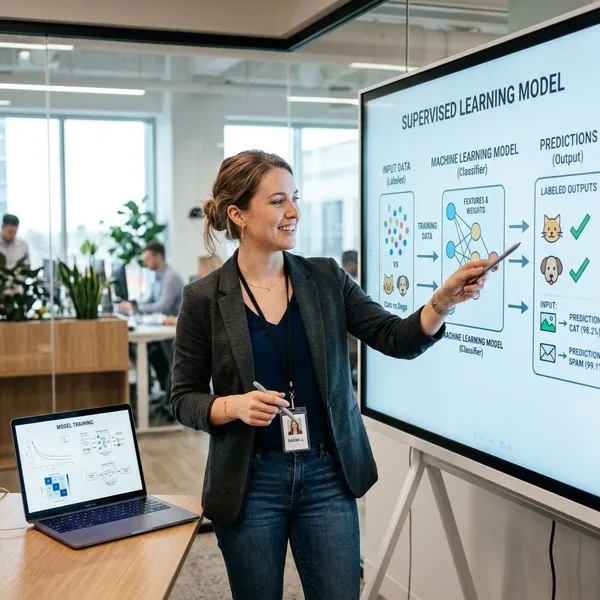
How does supervised learning work?
Supervised learning trains a model with examples that already include the correct answer. The model sees inputs, compares its prediction with the known output, and gradually learns which patterns are useful.
Train on labeled examples
Labeled examples are the teaching signal in supervised learning. In a loan dataset, the inputs might include income, debt level, and repayment history, while the label shows whether the borrower repaid the loan.
The labels matter as much as the algorithm. A large dataset with messy, outdated, or inconsistent labels can lead to a model that looks confident but learns the wrong lesson. Before choosing supervised learning, check whether the labels are reliable enough to represent the decision you actually want to make.
Learn input-to-output patterns
The model looks for relationships between the input features and the target output. A delivery-time model, for example, may learn that distance, traffic patterns, warehouse location, and order time all affect the final estimate.
- Useful pattern: applies to new cases, not just old records.
- Weak pattern: works only because the training data contains quirks or shortcuts.
- Warning sign: performance is high in testing but drops sharply in real use.
Predict labels or values
Supervised learning usually handles two kinds of prediction. Classification predicts a category, such as "spam" or "not spam." Regression predicts a number, such as revenue, price, risk score, or delivery time.
Measure against known answers
Because supervised learning uses known answers, evaluation is more direct. You can test the model on data it has not seen and compare its predictions with the real labels or values.
For classification, teams often look at accuracy, precision, recall, or F1 score. For regression, they may use error measures such as MAE or RMSE. The best metric depends on the mistake you care about most: a fraud model that misses risky transactions needs a different evaluation priority than a product forecast that is slightly off by a few units.

How does unsupervised learning work?
Unsupervised learning works with data that has no answer key. Instead of learning a known target, the model searches for structure: clusters, unusual records, repeated patterns, associations, or simpler representations of complex data.
Train on unlabeled data
Unlabeled data contains inputs without correct outputs. That might be browsing sessions, transaction logs, product views, support messages, sensor readings, or documents. The model can start working without a human labeling every record, but the result still needs human judgment before anyone treats it as useful.
Find hidden patterns
Unsupervised learning is often used when the interesting pattern has not been defined in advance. A retailer might discover that certain products are often bought together. A cybersecurity team might notice behavior that does not match normal network activity.
The value is not that the model magically "knows" what the pattern means. The value is that it can surface relationships worth checking. A discovered group or anomaly should be treated as a lead, not as a final answer.
Group or simplify data
Two common uses are clustering and dimensionality reduction. Clustering groups similar records together. Dimensionality reduction makes large, complex datasets easier to inspect or use in later modeling.
- Customer segmentation: group buyers by behavior instead of guessing categories manually.
- Document grouping: organize large text collections by similarity.
- Data visualization: reduce many variables into a view people can understand.
- Preprocessing: simplify noisy data before a supervised model is trained.
Interpret the results
Interpretation is the hard part of unsupervised learning. A cluster may be mathematically clear but useless for a real decision. Another cluster may look messy but reveal a valuable group of high-risk users, seasonal buyers, or unusual transactions.
When should you use supervised learning?
Use supervised learning when you already know the outcome you want to predict and you have examples where that outcome is recorded. It is strongest when the task needs a measurable answer, not just a better understanding of the dataset.
When labeled data is available
If your dataset already includes dependable labels, supervised learning becomes realistic. Examples include resolved support tickets, confirmed fraud cases, product categories, diagnosis records, or past customer churn outcomes.
Do not only ask whether labels exist. Ask who created them, whether they are consistent, and whether they still match current behavior. Old labels from a previous business process can quietly damage a model.
When the target is clearly defined
A clear target means the model's job can be stated in one direct sentence: predict whether a user will cancel, estimate next month's demand, classify an image, or score the risk of a transaction.
If the team cannot agree on the target, supervised learning is usually premature. Building a model before defining the answer often produces a technically polished result that no one knows how to use.
When you need measurable predictions
Supervised learning is the better choice when stakeholders need performance numbers before trusting the model. That matters in higher-risk settings such as finance, healthcare, insurance, cybersecurity, or any workflow where a wrong prediction can affect people or money.
- Use supervised learning when you need an error rate, precision target, or forecast accuracy range.
- Be cautious when the cost of a wrong prediction is high and the labels are incomplete.
- Monitor after launch because model performance can drift when behavior changes.
When past examples can guide future results
Supervised learning assumes the past still contains useful signals for the future. That works well for repeated patterns such as seasonal sales, common support issues, routine fraud signals, or stable product demand.
It becomes weaker when the world changes faster than the training data. A model trained before a major market shift, policy change, or product redesign may need fresh labels before its predictions are worth trusting.
When should you use unsupervised learning?
Use unsupervised learning when you do not have labels, do not yet know the right categories, or want to explore what structure exists in the data. It is less about getting a final prediction and more about finding a useful way to understand messy information.
When labels are unavailable
Unsupervised learning is often the practical starting point when labeling would take too long, cost too much, or require experts. Raw logs, browsing histories, sensor streams, and large text archives often fall into this category.
This does not mean labels are never needed. The patterns found early can help you decide which records are worth labeling later, which can save effort compared with labeling everything blindly.
When you want to discover patterns
Choose unsupervised learning when the goal is to find relationships you have not already named. Product pairings, unusual user behavior, document themes, and hidden customer segments are all examples.
When you need to group similar data
Clustering is useful when a dataset is too large or mixed to inspect record by record. It can turn thousands or millions of items into smaller groups that are easier to compare.
- Marketing: find audience groups based on behavior.
- Support: group similar complaints before designing categories.
- Operations: identify typical and unusual activity patterns.
When you are exploring a new dataset
For a new dataset, unsupervised learning can reveal outliers, duplicate patterns, surprising groupings, or variables that add little value. That makes it useful before committing to a supervised model.
This is especially helpful in an early research or pilot phase. You are not trying to prove final accuracy yet; you are trying to avoid building the wrong model around assumptions that the data does not support.
How to choose between supervised and unsupervised learning
Start with two checks: whether the data has reliable labels and whether your goal is prediction or discovery. Those two answers usually narrow the choice quickly.
| Project situation | Better starting point | Why it fits |
|---|---|---|
| You have trusted labels and need a specific output | Supervised learning | The model can learn from known answers and be measured directly. |
| You have raw data but no defined target | Unsupervised learning | The model can reveal groups, patterns, or anomalies first. |
| You have a small labeled set and much more unlabeled data | Semi-supervised or mixed workflow | The labels provide guidance while the unlabeled data adds scale. |
| You need both segments and predictions | Use both in stages | Explore or group the data first, then train a supervised model. |
Check whether your data is labeled
This is the first practical filter. If each record has a trusted target value or category, supervised learning is possible. If the dataset only contains raw inputs, unsupervised learning is usually the more realistic starting point.
Partly labeled data sits in the middle. You might label more examples, use the labeled subset for a supervised baseline, or try a semi-supervised approach if full labeling is not practical.
Define prediction or discovery as the goal
A prediction goal asks for a specific output: "Will this customer churn?" or "What will demand be next week?" A discovery goal asks what structure exists: "Which customer groups appear?" or "What unusual behavior can we find?"
If you skip this step, the method choice becomes fuzzy. A model can produce clusters or predictions, but that does not mean the output answers the question the project actually cares about.
Decide how results will be evaluated
Supervised results can be checked against known answers. Unsupervised results usually need a mix of internal measures, human review, and practical usefulness.
Before building anything, decide what "good enough" means. For a forecast, that might be an acceptable error range. For clustering, it might be whether the groups are stable, explainable, and useful for a real decision such as campaign planning or risk review.
Consider the cost of creating labels
Labeling can be the hidden cost in a machine learning project. Some labels are easy to create, such as tagging simple product categories. Others require domain experts, privacy review, or careful quality control.
- Choose supervised learning when labels already exist or are affordable to create.
- Start unsupervised when labeling everything would delay the project too much.
- Use a mixed approach when a small labeled sample can guide work on a much larger unlabeled dataset.

Conclusion
The safest choice is to match the method to the question instead of starting with the algorithm. If you have reliable labels and need a measurable prediction, supervised learning is usually the better route; if you have unlabeled data and need to uncover structure first, unsupervised learning gives you a more useful starting point. When the project needs both exploration and prediction, using the two methods in sequence is often more practical than forcing one approach to do everything.