Can Auditory Study Methods Improve Learning?
If you enjoy lectures, podcasts, or talking ideas through, auditory learning can be a useful study route—but it works best when listening is active. The first thing to check is the task: audio helps a lot with explanations, discussion, pronunciation, and spoken recall, but it should not replace practice, diagrams, notes, or self-testing when those fit the material better.
What Is Auditory Learning?
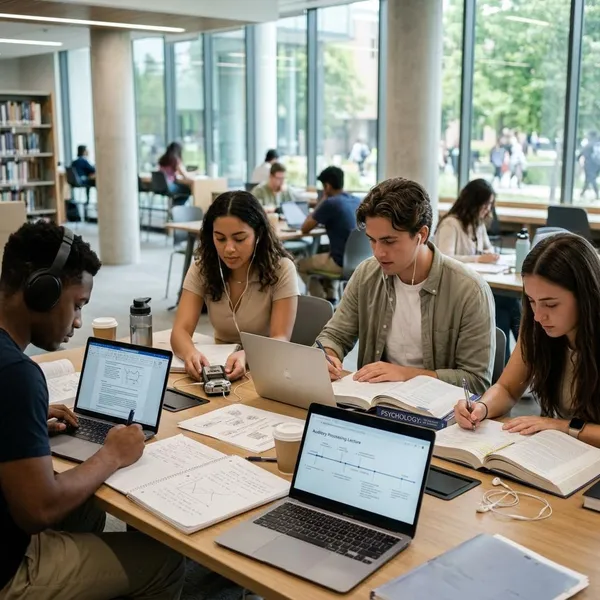
Auditory learning means using sound—spoken explanations, discussion, repetition, rhythm, or listening practice—as part of how you understand and remember information. Someone with an auditory preference may find it easier to follow a teacher's explanation than a dense handout, or they may remember a point better after saying it aloud.
It is better to treat this as a preference, not a fixed learner type. You might like hearing a topic first, but still need a diagram for anatomy, written examples for grammar, or practice problems for math. The useful question is not "Am I an auditory learner?" but "Will listening or speaking help with this specific task?"
Common signs of an auditory preference include remembering spoken instructions, thinking through problems out loud, enjoying discussion, noticing tone and emphasis, or using repetition to hold information in memory. Those signs can guide your study routine, as long as they do not become a box that limits how you learn.
Auditory Preferences vs Learning Styles
The popular idea of "learning styles" often makes it sound as if every person has one best channel. Evidence does not strongly support that simple version. Preferences matter because they affect attention and motivation, but long-term learning depends more on active recall, practice, feedback, and whether the method matches the subject.
A practical way to use an auditory preference is to let sound support the hard part of learning, not hide it. If listening helps you begin, use it. Then check whether you can explain, apply, or answer questions without the recording.
Enjoying listening does not prove better recall
A lecture can feel clear while you are hearing it and still disappear from memory later. That is the trap with passive audio: it creates familiarity, which can feel like learning, but recall is tested when the sound stops.
Learning preferences are not fixed abilities
Preferences can change by subject, confidence, and experience. A learner may prefer spoken explanations in biology but need written steps in algebra. Someone learning a language may depend heavily on audio for pronunciation, then switch to reading and writing when grammar becomes the focus.
That matters because an auditory preference should never mean "I cannot learn visually" or "I should avoid hands-on practice." It simply means sound may be a good entry point.
Study methods should match the task
Start with the outcome you need. If the task depends on sound, such as pronunciation or public speaking, audio should be central. If the task depends on spatial relationships, calculations, or interpreting graphs, audio can support learning but should not carry the whole routine.
| Study goal | Best first move | Where audio helps |
|---|---|---|
| Understand a difficult concept | Hear or read a clear explanation | Explain it aloud in your own words |
| Learn pronunciation | Listen to accurate examples | Repeat, record, and compare your speech |
| Read a diagram or process | Use the visual material directly | Talk through each part or step |
| Prepare for a test | Answer practice questions | Speak answers before checking notes |
Examples of Auditory Learning
Auditory learning shows up whenever sound helps someone make sense of information. The strongest examples are active: the learner listens carefully, responds, repeats, explains, or compares what they hear with what they already know.
Listening to explanations
A spoken explanation can make a hard topic easier because the speaker controls pace, emphasis, and order. This is especially useful for beginners who feel lost in a textbook. Hearing the big idea first can make the reading less intimidating afterward.
For example, a student starting a new science unit might listen to a short teacher explanation, then read the textbook section with a clearer map of what matters. The audio is not replacing the reading; it is making the reading easier to use.
Discussing ideas with others
Conversation is powerful because it forces you to organize your thinking in real time. If you cannot explain a point to a study partner, you have found a gap worth fixing.
- Use discussion for "why" and "how" questions.
- Ask your partner to challenge one unclear part.
- Keep the topic narrow so the talk does not drift.
Reading material aloud
Reading aloud can slow you down in a helpful way. It is useful for speeches, poetry, language learning, and dense passages where silent skimming causes you to miss structure or tone.
The limit is time and attention. Reading a whole chapter aloud may become tiring without improving recall. A better routine is to read one short section, close the book, and say the main idea in plain language.
Practicing pronunciation through audio
Pronunciation is one area where audio is not optional. Text can show spelling, but it cannot fully show stress, rhythm, intonation, or subtle sound differences. A language learner should listen, repeat, record, and compare rather than rely only on written rules.
The same idea applies to music, speech practice, and presentations. If the final skill is spoken or heard, the practice needs sound.
How to Study With Audio
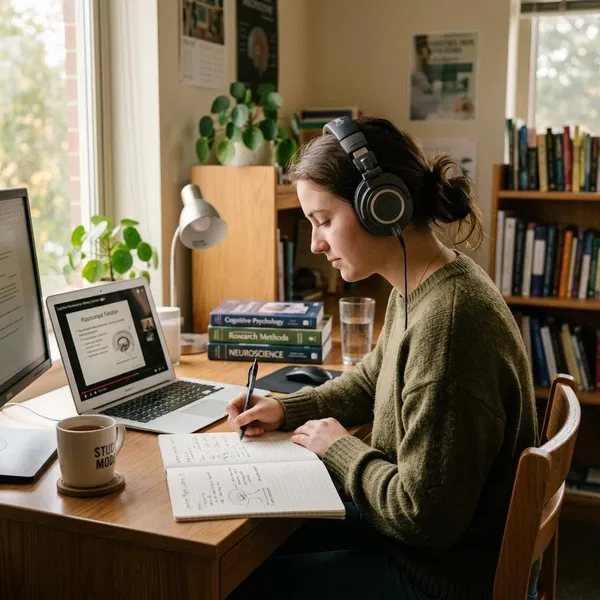
Audio study works best in short, focused rounds. The priority is not to listen for longer, but to turn what you hear into something you can recall, explain, and use later.
If you only have ten minutes, spend five minutes listening and five minutes testing yourself. That usually beats replaying the same recording while doing something else.
Pause recordings and recall key points
Listen to a short section, pause, and say the main idea without notes. Two to five minutes is often enough before stopping, especially with new material.
If you get stuck, do not restart the entire recording. Replay the exact part that caused trouble, then explain it again. That small loop keeps the session active and prevents false confidence.
Explain concepts without reading your notes
Try a one-minute explanation as if you were helping a friend who missed class. Use normal language, not memorized textbook wording. If your explanation falls apart, you have found the part to review.
This is especially useful before an exam or presentation because it tests whether ideas connect. Recognizing a term on the page is easier than explaining what it means and why it matters.
Answer practice questions aloud
Speaking answers aloud is a quick way to make practice harder in a useful way. Instead of thinking "I know that," you have to produce a complete answer.
- For oral exams, practice full spoken answers.
- For written exams, speak first, then write a tighter version.
- For interviews, record one answer and listen for vague wording.
Combine spoken explanations with diagrams
Some topics are too visual for audio alone. If you are learning blood flow, a geometry proof, a map, or a cycle diagram, look at the visual while talking through it step by step.
This is a good option for learners who prefer audio but keep losing track of relationships. The diagram holds the structure in place while your spoken explanation adds meaning.
Revisit material across several sessions
One long listening session is usually weaker than a few shorter sessions spread out over time. A simple routine is: listen and recall today, explain from memory tomorrow, then return a few days later with practice questions or a new example.
Use replay as a check, not as the first move every time. If you always replay before trying to remember, you may be training recognition instead of recall.
How Teachers Can Support Learning Through Sound
Teachers do not need to build a lesson around a single learning-style label. The more useful approach is to make spoken information clear, give students chances to verbalize ideas, and pair sound with other supports when the task demands it.
Give clear spoken instructions
Short, ordered instructions are easier to follow than long explanations with several side notes. State the task, name the first step, and check that students know what to do next.
For a complex activity, ask one student to restate the instructions in their own words. That quick spoken recall is often more useful than asking, "Does everyone understand?"
Build in discussion and verbal explanations
Discussion works best when the prompt is specific. "Explain the three causes in order" gives students more to work with than "Talk about the chapter."
Pair discussion can also help quieter students. They get a low-pressure chance to test their thinking before speaking in front of the whole class.
Pair audio with text and visuals
Spoken explanation is easier to use when students also have something stable to look at. A teacher might explain a chart while students mark key points, or read a passage aloud while students underline the sentence that carries the main claim.
This pairing is especially important when the material is new, detailed, or easy to misunderstand. If a student misses one sentence, the written or visual support gives them a way back in.
Reduce background noise
Not all sound supports learning. Side conversations, hallway noise, music with lyrics, or overlapping instructions can make listening harder, even for students who like audio.
- Pause before giving important directions.
- Avoid talking over group noise.
- Use music only when it fits the task.
- Give students a quieter option when possible.
Conclusion
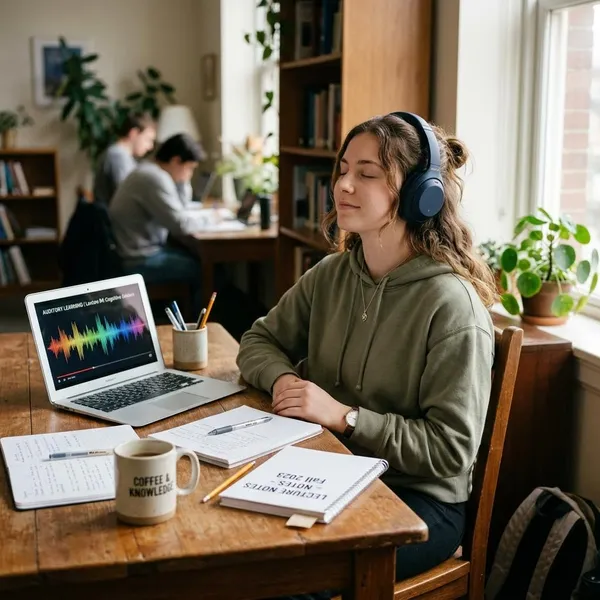
Auditory learning is most useful when it helps you do something active: explain, recall, discuss, compare, or practice sound-based skills. Use listening as a starting point when it helps, but judge the method by what you can remember and apply without support. If audio makes study easier to begin and active recall makes it stick, the combination is worth keeping.