How Can Active Learning Improve Classroom Learning?
Active learning works best when students do something meaningful with a new idea before the lesson moves on. That might be solving one problem, explaining a choice, comparing examples, or writing down what still feels unclear. The goal is not to make every class noisy or activity-heavy; it is to make student thinking visible while there is still time to guide it.

What is active learning?
Active learning is a teaching approach where students process, use, or question what they are learning during the lesson. Instead of only listening to an explanation, they are asked to think with the content in a visible way.
That does not mean direct teaching disappears. A clear explanation may still be the starting point, especially when a topic is new. The difference is what happens next: students get a short, purposeful chance to test the idea, apply it, or notice what they do and do not understand.
Students think through ideas
Students think through ideas when they make predictions, compare examples, explain reasoning, or decide which answer is stronger. This matters because a student can appear to follow a lesson while still missing the logic behind it.
Students apply what they learn
Application is the point where a concept becomes usable. A student who can repeat a definition may still struggle when the same idea appears in a new problem, sentence, graph, or case.
- Math: solve one problem and explain the method.
- Language: revise a sentence using the rule just taught.
- Science: connect a concept to a small classroom demonstration.
- Social studies: use a new term to interpret a current event or scenario.
Short tasks are often enough. The activity only needs to show whether students can use the idea, not whether they can complete a long assignment.
Students reflect on their understanding
Reflection gives students a moment to check their own learning. A one-sentence exit response, a confidence rating, or a prompt such as "What part still feels unclear?" can reveal more than a long stretch of quiet listening.
This is especially useful for students who do not usually ask questions out loud. A quick written reflection can show confusion without putting them on the spot, and it gives the teacher a better sense of what needs attention next.
How active and passive learning differ
Active and passive learning mainly differ in the student's role during the lesson. Passive learning focuses on receiving information. Active learning asks students to respond to, use, test, or reflect on that information before the lesson is over.
Passive learning is not automatically bad. A short lecture, demonstration, or reading can be the clearest way to introduce something unfamiliar. The problem comes when students stay in receiving mode for too long and no one knows whether the idea has actually landed.
| During the lesson | Passive learning tends to look like | Active learning tends to look like |
|---|---|---|
| Student role | Listening, watching, copying | Explaining, choosing, solving, questioning |
| Teacher role | Delivering most of the thinking | Guiding students through the thinking |
| Feedback timing | Often after homework, quizzes, or tests | During the lesson, while adjustment is still possible |

What students do during a lesson
In a passive lesson, students may listen carefully and still leave without being able to use the idea independently. In an active lesson, they have to do something with the content: choose an answer, justify a choice, sort examples, correct an error, or explain a step.
How teachers guide learning
The teacher's role becomes more intentional, not less important. Teachers choose the examples, set the task, decide how much support students need, and listen for patterns in student thinking.
In a beginner class, that might mean modeling one example first and then asking students to try a nearly identical one. In a more advanced class, it might mean giving students a messy example and asking them to defend the best solution. The amount of independence changes, but the task still needs a clear learning purpose.
How understanding is checked
Active learning checks understanding before the class has moved too far ahead. A quick poll, one written response, a mini whiteboard answer, or a pair explanation can show whether students are ready for the next step.
The most useful checks are not always graded. Their value is speed: they help the teacher decide whether to reteach, give another example, let students continue, or pause for a common misconception.
What are the benefits of active learning?
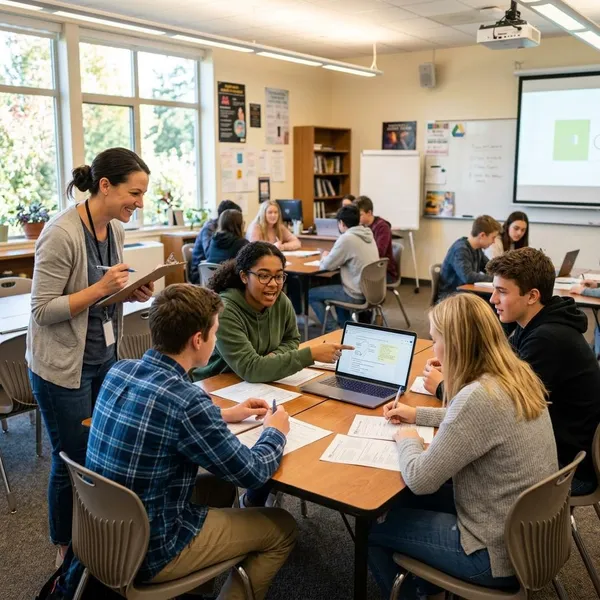
The biggest benefit of active learning is not that lessons feel busier. It is that students get guided practice with the kind of thinking they will need later on their own.
That makes class time more useful. Instead of discovering confusion only after homework or a test, teachers can see learning gaps earlier and students can correct weak understanding while the topic is still fresh.
Better understanding and test performance
Students often perform better when they have already practiced applying, explaining, or comparing ideas during class. Many assessments ask for more than recognition, so class activities should not stop at recognition either.
This does not mean every lesson needs a large project or group task. A two-minute question that asks students to justify an answer can be more valuable than a longer activity that only keeps them busy.
More practice with reasoning and problem-solving
Reasoning improves with repeated attempts. Active learning gives students those attempts in a lower-risk setting, where they can hear other approaches, revise an answer, and learn what makes an explanation stronger.
- Good use: "Which answer is best, and what evidence supports it?"
- Weak use: "Discuss the topic" with no clear outcome.
- Good use: "Find the mistake in this solution and correct it."
- Weak use: "Work together" without a thinking target.
Earlier feedback on learning gaps
Active learning makes hidden confusion easier to spot. If half the class chooses the same wrong answer, that is not a failure of the activity; it is useful information.
For a teacher with limited time, this is one of the strongest reasons to use active learning. It shows what to fix now, what can wait, and which students may need a quieter follow-up rather than a public correction.
How to add active learning to a lesson
The safest way to add active learning is to start small. Choose one point in the lesson where students usually only listen, then add a short task that shows whether they understand the main idea.
Choose one learning goal
Start with the exact learning goal, not the activity. "Understand fractions" is too broad for a quick check; "compare two fractions using a visual model" gives students and the teacher something clearer to aim for.
This matters most when time is tight. If you only have five spare minutes, a narrow goal helps you avoid a vague discussion that feels active but does not reveal much.
Design a task that tests that goal
The task should require the same kind of thinking as the goal. If students need to compare, ask them to compare. If they need to explain, ask for an explanation. If they need to apply a rule, give them a fresh example where the rule has to be used.
- For recall: ask for one key term or fact.
- For application: give one problem or scenario.
- For reasoning: ask students to justify the better answer.
- For misconception checks: show a wrong answer and ask what went wrong.
Give clear instructions and thinking time
Students need to know what to produce, how long they have, and whether they should work alone, with a partner, or as a group. Without that clarity, the activity can turn into confusion about directions rather than thinking about the content.
Silent thinking time is worth protecting. Even 30 to 60 seconds before discussion can improve answer quality and make participation fairer for quieter students, second-language learners, or anyone who needs a moment before speaking.
Discuss answers and address gaps
The follow-up is where the learning often happens. Do not stop at "correct" or "incorrect." Ask why an answer works, compare two responses, or name the misconception that led to a common mistake.
For online teaching, this step may need to be more deliberate. A poll can show the pattern, but students still need a short explanation, shared example, or revised response so the feedback does not disappear into the platform.
Conclusion
Active learning is most useful when it is small, focused, and tied to a real learning goal. Start by asking what students should be able to do with the idea, then build one short moment where they have to show that thinking. If the activity gives you evidence you can respond to, it is doing its job.