How Can You Build a Strong Music Theory Foundation?
If you want to create a foundational curriculum for effectively learning music theory, build it around usable skills rather than a long list of terms. The safest order is notation and rhythm first, then scales, intervals, chords, harmony, ear training, and simple music-making tasks. A learner should always be able to read it, hear it, and use it before moving too far ahead.

What should a foundational music theory curriculum achieve?
A good beginner curriculum should produce five practical abilities: reading basic notation, counting common rhythms, building scales and chords, recognizing simple sounds by ear, and applying theory while making music. If one of those areas is missing, the learner usually develops a gap that shows up later.
- Most important: connect every written concept to sound.
- Next priority: repeat skills in short, regular sessions.
- Optional depth: add extra terminology only when the learner can use the core idea.
Read basic music notation
Start with the musical alphabet, staff lines and spaces, treble and bass clefs, measures, bar lines, repeat signs, accidentals, and simple dynamics. The goal is not instant sight-reading; it is enough early fluency that a learner can locate notes without stopping every few seconds.
Connect symbols to sound immediately. When Middle C appears on the staff, the learner should play it, sing it, or find it on a keyboard app. Pure note-naming drills help, but they are weaker when the student never hears the pitch.
Count common rhythms
Rhythm should be counted, clapped, tapped, and played. Whole, half, quarter, and eighth notes are a good starting set, followed by rests, 4/4, 3/4, and later 6/8 when the learner is ready for compound feel.
- Use counting aloud before silent reading.
- Keep a steady pulse with tapping or a metronome.
- Fix rushing early before adding harder rhythms.
Build scales and chords
Scales and chords give beginners a map of how notes relate. Teach the major scale pattern first, then simple key signatures, natural minor, intervals, triads, and inversions. At this level, it is better for a learner to build C major, G major, F major, A minor, and E minor confidently than to rush through every key on paper.
Recognize basic sounds by ear
Ear work should begin with pitch matching, high versus low, notes moving up or down, and major versus minor contrast. Those tasks are simple enough for beginners, but they prevent theory from becoming only a visual subject.
Apply theory while making music
The curriculum is working when each concept turns into action. A scale should be played and sung. A triad should be written, heard, and found in a song. A rhythm should be counted, clapped, and used in a short phrase.
What is the best order for learning music theory?
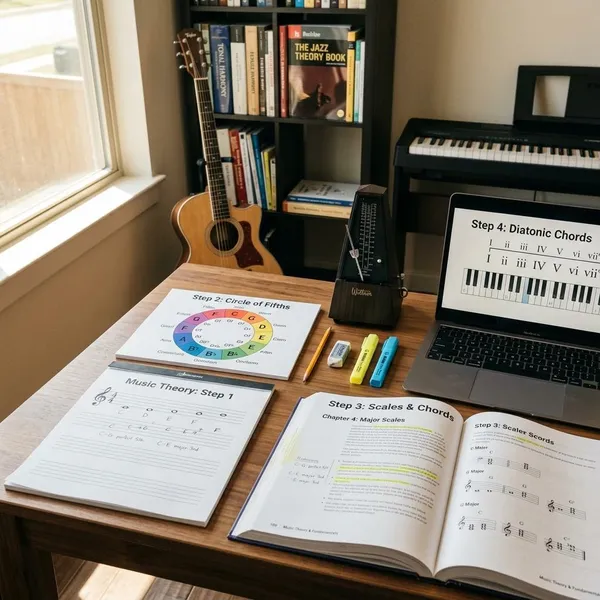
The best order is cumulative: notation and rhythm, scales and keys, intervals and chords, basic harmony, then repeated practice that mixes old and new skills. The order can bend a little for the learner's instrument, but it should not become random.
- Map the basics: note names, staff reading, clefs, keyboard layout, and simple note values.
- Build timing: pulse, meter, subdivision, rests, and short rhythm patterns.
- Organize pitch: major scales, key signatures, minor scales, and tonal center.
- Stack notes: intervals, triads, inversions, and a few common seventh chords.
- Use harmony: chord function, cadences, short analysis, ear work, and writing tasks.
Start with notation and rhythm
Notation and rhythm are the first layer because they let the learner decode what is on the page and perform it in time. Keep this phase active: read a note, play it; see a rhythm, clap it; count a measure, then perform it without stopping.
Move to scales and keys
Scales should answer a practical question: which notes belong together in this piece? Start with whole and half steps in the major scale, then key signatures and the circle of fifths as a pattern-recognition tool, not as a chart to memorize blindly.
Add intervals and chords
Intervals explain the distance between notes, and chords show what happens when those distances stack. Teach seconds, thirds, fourths, fifths, and octaves before expecting confident chord spelling.
- First: identify interval size by counting letter names.
- Then: add quality, such as major, minor, perfect, diminished, or augmented.
- Next: build major and minor triads from scale degrees.
- Later: introduce inversions and common seventh chords.
Introduce basic harmony
Basic harmony should come after the learner can build chords. At this stage, focus on function: tonic feels like home, dominant creates pull, and subdominant often moves the music away from home before returning.
Use a small set of progressions first, such as I-IV-V-I, I-V-vi-IV, and ii-V-I. A songwriter may want to test these progressions immediately in a song idea, while a classical beginner may understand them better by marking cadences in short pieces.
Reinforce each phase through practice
Review should be built into the weekly plan, not added only when something goes wrong. A student learning triads still needs rhythm checks. A student learning harmony still needs to sing scales and identify intervals.

How to include ear training in every phase
Ear training belongs in every phase because music theory describes sound. It does not need to be advanced at the beginning; it needs to be consistent and directly tied to the current topic.
Sing notes and scale patterns
Singing exposes what the learner truly hears. Start with pitch matching, then sing a major scale using note names, solfege, or scale-degree numbers. Short patterns such as 1-2-3-2-1 and 1-3-5-3-1 are more useful than long, unfocused vocal drills.
Clap and copy rhythms
Use short echo patterns: the teacher, app, or recording plays a rhythm, and the learner claps it back. Begin with quarter and eighth notes, then add rests, ties, dotted rhythms, and simple syncopation only after the pulse stays steady.
If the learner keeps losing the beat, simplify the rhythm instead of increasing the tempo. Accuracy at a slower speed is a better sign of progress than a fast but unstable performance.
Identify intervals by ear
Begin with very clear contrasts: repeated notes, stepwise motion, perfect fifth, octave, major third, and minor third. Song references can help at first, but they should not become the only strategy.
Recognize chord qualities
Major and minor triads are enough at the start. Once that contrast is reliable, add diminished, augmented, dominant seventh, and major seventh sounds. The point is not to guess labels quickly; it is to connect chord color with actual musical use.
Write short melodic dictations
Melodic dictation can be beginner-friendly if it stays tiny. Use three to five notes in a familiar key with simple rhythm. Ask first whether the melody moves up, down, or repeats, then have the learner notate it.
How to turn theory into practical musicianship
Theory becomes useful when it changes how someone plays, sings, listens, writes, or understands music. For that reason, every topic should end with a small practical task, not just a definition.
Play each concept on an instrument
Every new idea should touch an instrument or voice. A learner who writes C-E-G should also play or sing C-E-G. A keyboard is convenient because the layout is clear, but guitar, voice, strings, wind instruments, and keyboard apps can all work.
Find examples in familiar songs
Use music the learner already knows to make theory less abstract. Look for repeated rhythms, major and minor moods, scale fragments, cadences, and simple progressions.
Analyze short pieces
Beginner analysis should stay small: key, time signature, phrase length, repeated rhythm, stepwise motion, leaps, and obvious chord movement. The goal is pattern recognition, not a formal essay.
- Mark the key before labeling chords.
- Circle repeated ideas so the music feels less random.
- Notice phrase endings because cadences often reveal structure.
Improvise with new material
Improvisation does not have to mean jazz solos or advanced playing. After learning a five-note scale, ask for a two-measure melody. After learning a triad, ask for an arpeggio in two rhythms. Limits make the task safer and more useful.
Write simple melodies and progressions
Writing forces musical decisions. Assign a four-measure melody in C major, a rhythm in 3/4, or a short I-IV-V-I progression. The result does not need to be beautiful; it needs to show that the learner can choose notes and organize time.

How to measure progress in music theory
Progress should be measured by what the learner can do, not only by what they can define. A practical checkpoint asks whether the student can read, count, hear, build, play, and create with the material at a beginner level.
| Skill area | Useful checkpoint | Review if this happens |
|---|---|---|
| Notation | Names notes quickly on staff and instrument | Correct answers take too long |
| Rhythm | Claps and counts short patterns steadily | Pulse disappears during rests or ties |
| Scales and chords | Builds and plays common examples | Uses guessing instead of patterns |
| Ear training | Matches pitch and hears basic contrasts | Can label on paper but not by sound |
| Musicianship | Uses theory in a short performance or writing task | Knowledge stays separate from music-making |
Short notation quizzes
Keep notation quizzes brief: identify staff notes, write a note on the staff, label keyboard pitches, or add a missing accidental. Speed matters, because reading that is technically correct but painfully slow will still interrupt playing.
Rhythm reading checks
Rhythm checks should be performed out loud or with the body. Ask the learner to count, clap, tap, or play a short pattern while keeping a steady beat.
Scale and chord exercises
Ask learners to build a scale from a given note, identify a key signature, spell a triad, play an inversion, or sing a simple arpeggio. These exercises reveal whether the learner understands the pattern or is relying on memorized answers.
- Acceptable: slow but pattern-based construction.
- Needs review: random guessing or counting every answer from C.
- Ready to move on: written, played, and heard examples mostly agree.
Ear training tests
Test the ear in small pieces: match a pitch, hear up or down, clap back a rhythm, identify major versus minor, or notate a three-note pattern. These checks should feel normal, not like a separate exam.
Performance and composition tasks
Performance and composition tasks are the best final proof. Have the learner sight-read a short melody, perform a scale evenly, accompany a tune with simple chords, improvise within a limited scale, or write a short phrase using a given rhythm.
Conclusion
A strong beginner curriculum is not the one that covers the most theory terms; it is the one that builds a reliable loop between reading, hearing, playing, and creating. Move in a clear order, check skills before adding complexity, and keep the work musical from the first week. When a learner can use a concept in sound instead of only naming it, the foundation is doing its job.