How Can AI Help You Learn Math Better?
The best AI for math learning depends on the job: exact calculation, step-by-step tutoring, adaptive practice, or a quick homework check. Start by asking what you need most right now: a reliable answer, a clearer explanation, more practice, or help finding the mistake in your own work.
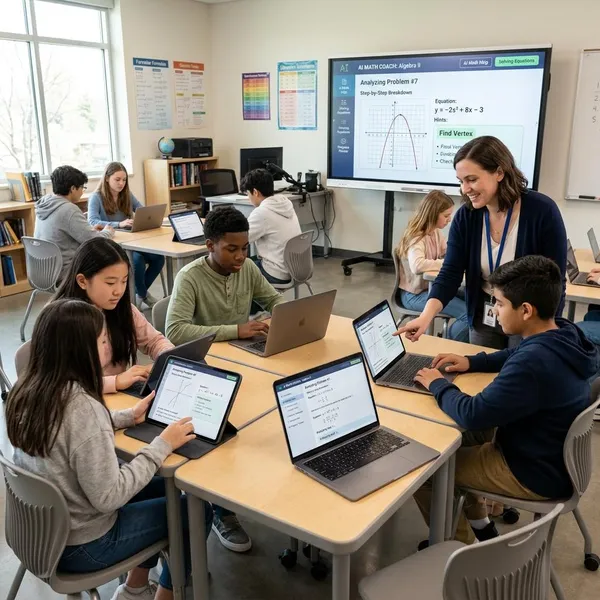
Best AI tools for math learning
No single math tool is best for every student. A high school student checking algebra homework needs something different from a college student working through calculus, and both are different from a learner trying to rebuild weak foundations over several months.
| Tool | Best fit | Use it carefully when |
|---|---|---|
| Wolfram Alpha | Advanced calculations, symbolic math, graphs, calculus | You need a beginner-friendly explanation |
| Mathos AI | Step-by-step tutoring and follow-up practice | You are working on graded work and must show your own reasoning |
| Math Academy | Long-term adaptive learning and filling skill gaps | You only need one quick homework answer |
| Photomath | Fast scanned homework checks | You are tempted to copy before trying the problem |
Wolfram Alpha for advanced calculations
Use Wolfram Alpha when accuracy matters more than conversational coaching. It is especially useful for algebra, calculus, matrices, graphing, equations, and other STEM-heavy work where a general chatbot may give a confident but unreliable answer.
Mathos AI for step-by-step tutoring
Mathos AI is a better fit when the problem is not just "What is the answer?" but "Where did I get lost?" A tutoring-style tool can break a solution into smaller steps, explain the method, and create similar practice so the student does not stop at passive reading.
- Good for: students who need explanations plus practice.
- Less ideal for: students who only want exact symbolic computation.
- Best habit: try the problem first, then compare your work with the AI steps.
Math Academy for adaptive courses
Math Academy makes the most sense for long-term improvement. If a student keeps struggling with new units because older skills are weak, adaptive sequencing can be more useful than solving one problem at a time.
Photomath for scanned homework help
Photomath is convenient because it removes the typing problem. A student can scan a printed or handwritten problem and quickly see a worked solution, which is helpful for routine arithmetic, algebra, and textbook-style homework.
How AI can help you learn math
AI helps most when it shortens the time between getting stuck and getting useful feedback. That does not mean skipping the work. It means using the tool to see the next step, test your reasoning, or get more practice on the exact skill that is causing trouble.
Explains problems step by step
A good AI math tool does not jump straight from question to final answer. It shows the moves in between, which is where most math confusion happens.
This matters in topics like algebra and calculus, where one small transition can change everything. If you can point to the exact line where your work stopped matching the solution, the tool has helped you learn more than a plain answer key would.
Spots mistakes in your work
Mistake-spotting is one of the most practical uses of AI for math learning. A tool may catch a sign error, a wrong formula, a missed exponent rule, or a graphing mistake before the student repeats it across a whole worksheet.
- Best use: upload or type your own attempt first.
- Ask directly: "Where is the first mistake?" instead of "Solve this."
- Check the fix: redo the problem without looking at the full solution.
Adjusts practice to your level
Adaptive practice is useful for students with uneven foundations. If the tool notices that a learner keeps missing equation setup, it can offer easier setup problems before moving back to harder ones.
Creates extra questions and quizzes
AI can quickly make more practice when the textbook does not give enough examples. A student can ask for five easier fraction problems, ten factoring questions, or a short quiz on derivatives.
Gives feedback right away
Immediate feedback is helpful because math errors compound. If a student solves the first three equation problems incorrectly, waiting until tomorrow to find out can waste a lot of practice time.
Shows different ways to solve a problem
Some students understand a symbolic method first; others need a graph, table, or visual explanation. AI can sometimes show more than one route, which helps a learner see that math is not just memorizing one fixed procedure.

How to choose an AI math tool
The first thing to check is not price or popularity. Check whether the tool fits your subject, level, and learning goal. A tool that is excellent for calculus may be a poor choice for a seventh grader who needs patient explanations, and a scan-based homework app may not help someone with long-term gaps.
Match it to your math subject
For arithmetic and basic algebra, many homework apps can be enough. For calculus, matrices, graphing, statistics, or symbolic manipulation, a math-specific engine is usually safer than a general chatbot.
If the work involves word problems, check whether the tool explains the setup clearly. Getting the equation right is often harder than solving it.
Check the supported grade level
A middle school learner and a college engineering student need different explanations. Younger students usually benefit from simpler language, more visual support, and smaller steps. Advanced learners may need formal notation and faster movement through routine steps.
For younger children, it may be better for a parent or teacher to use the AI tool with them rather than letting the child treat every AI answer as correct.
Look for clear working steps
A tool that only gives final answers is not much of a learning tool. Look for clear working, not just a neat result.
- Good sign: each line explains the rule or reason used.
- Warning sign: several algebra steps are skipped with no explanation.
- Quick test: ask, "Why did this step happen?" and see if the answer is useful.
Test answers for accuracy
Before relying on a tool, test it with problems where you already know the answer. Use a textbook solution, teacher key, or trusted calculator as a comparison.
This is especially important for scanned images, unusual notation, and advanced topics. A blurry fraction bar or missing parenthesis can change the meaning of the whole problem.
Compare free and paid features
Free versions may be enough for occasional homework checking, but the most useful learning features are often paid: full steps, hints, progress tracking, or adaptive practice.
Review privacy and school rules
Math tools may collect typed questions, scanned homework, account details, and performance data. Parents and teachers should check what is stored, especially when younger students are involved.
School rules matter too. Some classrooms allow AI for hints or checking, while others treat it like outside help that must be disclosed. When in doubt, ask before using it on graded work.

Limits of AI for math learning
AI can make math practice easier, but it is not automatically trustworthy. The main limits are wrong answers, missing reasoning, overreliance, unequal access, privacy concerns, and the lack of real teacher judgment.
AI can produce wrong answers
General chatbots can make math mistakes while sounding confident. Math-specific tools are usually stronger, but they can still fail when input is unclear, notation is unusual, or the problem needs interpretation.
Explanations can skip key steps
An explanation can look complete and still skip the one step the student needed most. This often happens when the tool moves from one line to the next without naming the rule, substitution, or assumption.
Fast answers can encourage copying
The biggest learning risk is not that AI solves problems. It is that students may stop attempting problems before asking for help.
- Better order: attempt first, use AI second, redo independently third.
- Poor order: scan first, copy second, forget the method later.
Tool access can create learning gaps
AI support is not equal for everyone. A student with a paid subscription, reliable internet, and a personal device may get much more support than a student sharing one phone at home.
Teachers should be careful about making AI tools essential for homework unless every student has fair access.
Student data may raise privacy concerns
Scanned homework and typed questions can reveal more than people expect. They may include names, school details, class materials, or patterns in student performance.
AI cannot replace teacher feedback
A teacher can see habits that AI often misses: whether a student is guessing, rushing, using a class method incorrectly, or misunderstanding an earlier concept. AI can explain a procedure, but it does not fully understand the classroom context.
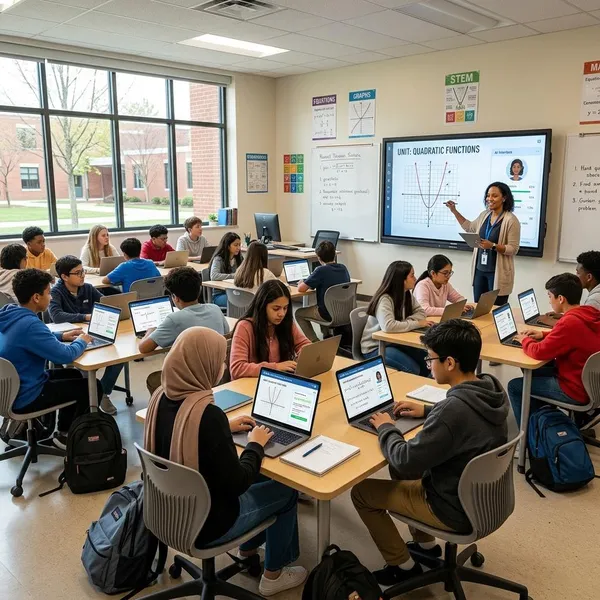
How teachers can use AI in math class
For teachers, AI is most useful as a planning and feedback support tool. It can help create practice, spot patterns, and draft examples, but the teacher still needs to check the math and decide what fits the lesson.
Create practice at different levels
AI can help turn one skill into several versions of practice. For example, one group may need simple linear equations, another may need equations with fractions, and another may be ready for word problems using the same concept.
Give students faster feedback
AI-supported practice can give students quick responses while they work. That is useful in larger classes where a teacher cannot check every step immediately.
Teacher feedback still matters most for reasoning, explanation quality, and strategy choice. Let AI handle some routine checks; save human attention for the thinking that needs interpretation.
Find common learning gaps
Some platforms can show patterns in student errors. If many students miss the same equation step, the teacher can pause and reteach before the class moves further ahead.
- Useful pattern: many students make the same procedural error.
- Teacher decision: whether to reteach, regroup, or give targeted practice.
- Risk: treating dashboard data as complete proof of understanding.
Build examples and review questions
AI can draft warm-ups, exit tickets, review sets, and extra examples quickly. This is helpful when a class needs more practice on yesterday's weak point.
Set clear rules for responsible use
Students need concrete rules, not vague warnings. A clear policy might say AI is allowed for hints after an attempt, allowed for checking completed work, but not allowed for producing full homework solutions.
It also helps to require students to explain any AI-assisted step in their own words. If they cannot explain it, they have not learned it yet.
Check AI output before sharing it
Teachers should treat AI output as a draft, not a finished resource. Check the answer, notation, difficulty level, wording, and whether the method matches what has been taught.
This review step is where teacher expertise matters. AI may save preparation time, but the teacher remains responsible for what enters the classroom.

Conclusion
The smart way to use AI for math is to decide what kind of help you need before choosing a tool. Use Wolfram Alpha when reliable computation matters, a tutoring tool when you need the steps explained, an adaptive course when gaps keep coming back, and a scan-based app only after you have tried the problem yourself. If the tool makes you more independent over time, it is helping; if it mainly makes copying easier, it is the wrong setup.