How Can Active Learning Boost Student Engagement?
Active learning strategies work best when they are chosen for a clear purpose, not added just to make a lesson feel busy. Start by asking what students need to do with the content: recall it, explain it, question it, apply it, or discuss it with others. Once that goal is clear, a short activity can often improve participation and understanding more than a longer, loosely planned task.

Why active learning works
Active learning works because students have to process information while the lesson is still happening. Instead of only listening, they retrieve ideas, test them, explain them, compare them, or use them to solve a problem. That gives teachers a better view of what students actually understand before a quiz or final assignment exposes the gaps.
Builds stronger understanding
Students understand ideas more deeply when they have to use them. For example, a history class comparing two causes of a conflict will usually reveal more thinking than a class that only copies the causes from a slide. The task forces students to sort, connect, and explain the content in their own words.
Improves long-term recall
Recall improves when students pull information from memory instead of only rereading it. A low-stakes quiz, a quick summary, or a "write everything you remember" pause helps students strengthen the path back to that knowledge.
- Best for review: quick retrieval quizzes or one-minute summaries.
- Best after new content: short explanation prompts in students' own words.
- Best before a test: mixed questions from earlier lessons, not only yesterday's topic.
Encourages wider participation
Whole-class discussion often rewards the fastest or most confident speakers. Active learning can make participation less risky by giving students time to think alone, talk with one partner, or write before speaking. This matters especially in classes where a few voices usually dominate.
Develops critical thinking
Critical thinking grows when students must justify a choice, compare options, question evidence, or revise an answer. A debate, concept map, case question, or peer explanation can show whether students are reasoning or simply repeating familiar terms.
Strengthens teamwork and communication
Group work becomes active learning only when students have a real thinking task and a clear way to contribute. "Discuss this" is usually too vague. A stronger task might ask one student to summarize, one to challenge the reasoning, and one to report the group's best answer.
Active learning strategies for discussion
Discussion strategies are useful when students need to explain, compare, defend, or listen to different viewpoints. The key is structure. Without a clear prompt and time limit, discussion can drift or leave too many students watching from the sidelines.
Think-pair-share
Think-pair-share is a reliable first choice because it gives students a private thinking moment before they speak. Ask a focused question, give students time to think, let them compare with a partner, then invite a few responses.
- Use it for: comparison, prediction, interpretation, or explaining a method.
- Keep it short: one minute to think, two minutes to pair, a few minutes to share.
- Avoid: questions that students can answer with "yes," "no," or one copied phrase.
Peer teaching
Peer teaching asks students to explain a concept or process to someone else. It works well for review because students quickly discover what they can explain clearly and what they only half understand.
For a low-risk version, pair students after individual practice and ask them to teach one step of a problem. For a more prepared class, small groups can teach short subtopics, but they need a checklist so accuracy does not get lost in presentation style.
Fishbowl discussions
Fishbowl discussions are useful when a topic needs careful listening. A small inner group discusses while the outer group observes for evidence, strong questions, or changes in reasoning. Then the groups switch or the observers respond.
Small-group debates
Small-group debates help students practice claims, evidence, and counterarguments without turning the room into one large performance. Give each group a specific position, a short preparation window, and a requirement to use class material as support.
Active learning strategies for checking understanding
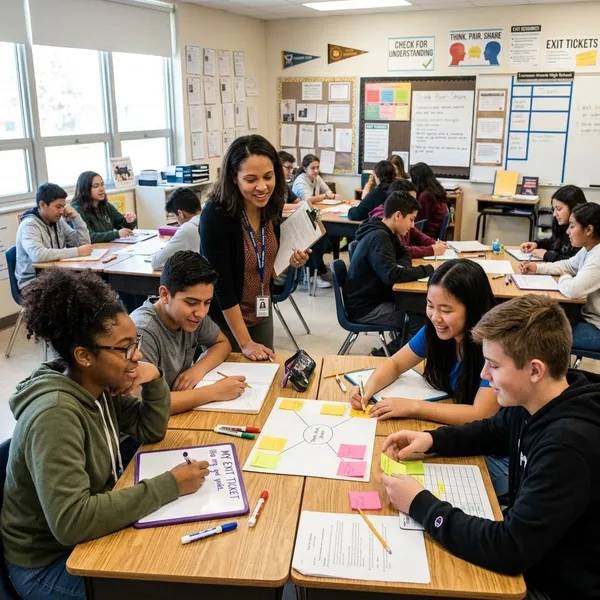
Checking understanding is where active learning becomes especially practical. These strategies help teachers see confusion early, while there is still time to adjust the lesson. They are also easier to manage than large group projects because most take only a few minutes.
The muddiest point
The muddiest point asks students to name the most confusing part of the lesson. It works best when the prompt requires precision: "What step, word, or example is still unclear?" is more useful than "What did you not understand?"
One-minute papers
A one-minute paper gives students a short written pause to process the lesson. Good prompts include "What was the most important idea today?" or "Where could you use this method?" The response does not need to be long; the value is in forcing a clear thought.
Quick retrieval quizzes
Quick retrieval quizzes are short, low-pressure checks that ask students to remember without looking at notes. They are especially useful at the start of class because they bring earlier learning back into working memory.
- Keep stakes low: completion, self-checking, or quick review is often enough.
- Mix old and new: include earlier content so students do not only cram recent material.
- Review immediately: correct misconceptions before they harden.
Concept mapping
Concept mapping asks students to show relationships between ideas with links, labels, arrows, or categories. It is a good choice when the topic has causes and effects, parts of a system, competing theories, or layered vocabulary.
Exit tickets
Exit tickets work well when the teacher needs a quick decision about the next lesson. Ask one question that matches the day's goal: solve one problem, explain one idea, name one confusion, or choose the best next step.

How to choose the right active learning strategy
The fastest way to choose a strategy is to start with the learning goal, then narrow the choice by time, class size, student readiness, and teaching format. A simple activity that fits the moment is usually better than an impressive activity that eats the lesson.
| Classroom need | Better strategy choices | Watch out for |
|---|---|---|
| Students need to remember key ideas | Retrieval quiz, exit ticket, one-minute paper | Turning every check into a graded test |
| Students need to compare or explain | Think-pair-share, concept map, peer teaching | Prompts that are too broad |
| Students need to defend a position | Small-group debate, fishbowl discussion | Opinion without evidence |
| Students are new to active learning | Low-risk writing or partner tasks | Starting with a complex group activity too soon |
Match it to the learning goal
Choose the activity based on the thinking students need to do. Recall calls for retrieval. Analysis calls for comparison, mapping, debate, or case work. Communication calls for peer explanation or structured discussion.
Check the time available
Time includes setup, directions, student work, transition, and debrief. If you have five minutes, use think-pair-share, a retrieval check, the muddiest point, or an exit ticket. If you have twenty minutes or more, a debate, fishbowl, or peer teaching task becomes more realistic.
Consider the class size
Large classes usually need structures that involve many students at once, such as pair work, polling, written responses, or small groups with clear roles. Smaller classes can handle full-group discussion more easily, but they still need a focused prompt so the conversation does not become casual talk.
Gauge student readiness
Students who are new to active learning may need simple routines before they can handle open-ended collaboration. Start with low-risk tasks: write first, then pair; answer individually, then compare; explain one step, not an entire topic.
Fit it to the teaching format
In-person classes can use paper responses, quick partner talk, board work, or physical grouping. Online classes need simpler instructions and tools that do not distract from the learning goal, such as chat prompts, shared documents, polls, or breakout rooms.
How to use active learning in a lesson
A good active learning segment needs a goal, a task, clear directions, enough structure, and a short closing move. It does not need to take over the whole lesson. For many teachers, the best starting point is replacing one long explanation with a short cycle of explanation, student action, and feedback.
Set one clear learning goal
Set one outcome students can actually show. "Understand the chapter" is too broad. "Explain why the character changes his decision" or "solve one problem using the new method" gives both teacher and students a clearer target.
Pick a focused activity
Choose one activity that supports that target directly. If the goal is to find confusion, use the muddiest point. If the goal is to practice memory, use retrieval. If the goal is to compare ideas, use a paired explanation or concept map.
Give short, clear instructions
Students need to know four things: what to do, how long they have, who they work with, and what they should produce. Put the instructions where students can see them, especially if the activity has more than one step.
Set roles and time limits
Roles prevent group work from turning into one student doing everything while others wait. Time limits prevent the task from stretching past its usefulness.
- Pairs: speaker A explains, speaker B checks or summarizes.
- Groups of three: recorder, reporter, evidence checker.
- Debates: claim maker, evidence finder, rebuttal speaker.
Monitor and support students
While students work, listen for patterns rather than trying to correct every sentence. Notice the misconception that keeps appearing, the example worth sharing, or the group that needs a narrower question.
End with feedback or reflection
Close the activity by naming what students should take from it. That might be a model answer, two common errors, a strong student example, or one reflection question. Without this final step, students may remember the task but miss the learning point.
Conclusion
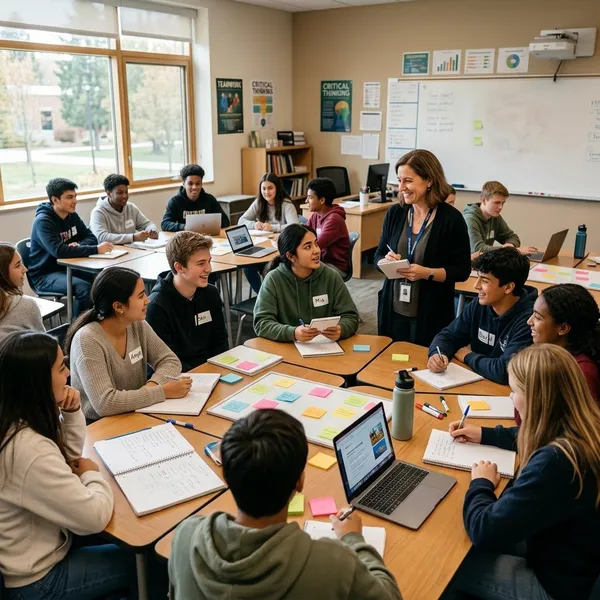
Active learning is most effective when it is small, purposeful, and connected to the lesson goal. Start with one strategy that reveals student thinking quickly, then build from there as routines become familiar. The practical test is simple: if the activity helps students think more clearly and helps you decide what to do next, it is worth keeping.